The Renaissance marked a significant shift in architectural thinking because it placed human experience and proportion at the centre of design. The movement which originated in Florence, Italy in the late 14th century, is often described as a period of European cultural, artistic, political, and scientific “rebirth” following the Middle Ages. Preceding movements included the Gothic and Romanesque, which drew heavily on religion. This period is where architecture began to draw inspiration from classical Roman and Greek ideals. Renaissance architecture focused on clarity, balance, and mathematical order, unlike the heavy and symbolic structures of the medieval period.
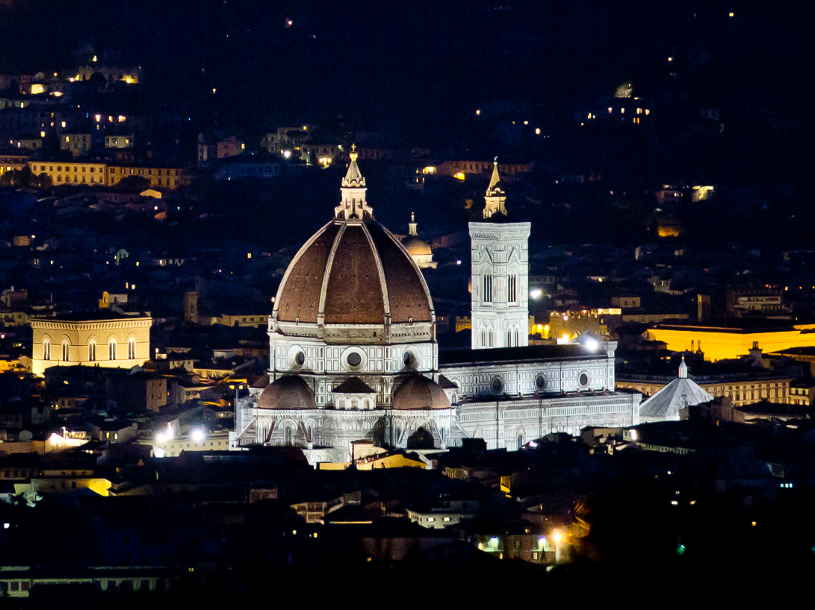
A key idea during this period was humanism. Buildings were designed using strict symmetry and proportional systems. This created spaces that felt logical and harmonious. Architects such as Filippo Brunelleschi demonstrated this through works like the dome of Florence Cathedral in Italy. Construction began in 1296 based on a design by Arnolfo di Cambio and was completed in 1436. This design, created by Arnolfo di Cambio (1232-1300), was unique as it featured a wide nave ending in an octagonal dome-like structure. No external buttresses were allowed, which would have been reminiscent of French churches, and the use of Roman concrete had not been used for centuries; however, the municipal government wanted the building to feature a dome like that of the Pantheon in Rome.
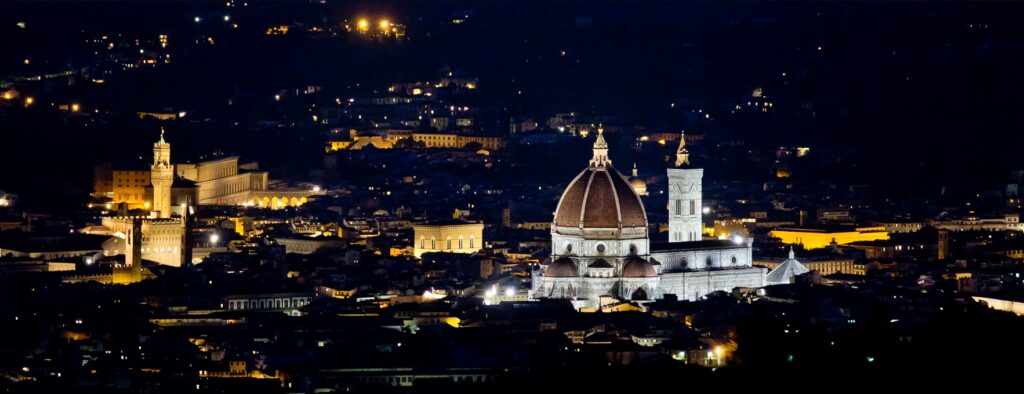
Fig.1 Florence Cathedral at night
The cathedral combined engineering innovation with geometric precision while incorporating Gothic, Romanesque, and early Renaissance influences. Similarly, Leon Battista Alberti developed architectural theories that emphasised harmony which reinforced the idea that beauty in architecture comes from proportion and balance. Perspective and proportion allowed Renaissance architects to create spaces that felt ordered and visually comprehensible to the people experiencing them.
What I find interesting about Renaissance architecture is how it contrasts with later movements such as Modernism. I have previously written about Modernism, and the difference is quite clear. Whilst the Renaissance emphasises human comfort, even drawing inspiration from human anatomy and proportion in architectural design, modernism deliberately breaks from that to prioritise the functional efficiency and rational order with the maxim ‘form follows function’. This was sometimes at the expense of emotional or sensory experience. This makes me question whether architecture should primarily aim for rational order, or whether it should always respond to how people feel within spaces.
References:
- Kaarwan Team. (n.d.). From God to man: A journey through Gothic and Renaissance architecture. https://www.kaarwan.com/blog/architecture/from-god-to-man-a-journey-through-gothic-and-renaissance-architecture?id=1467
- Ching, F. D. K., Jarzombek, M. M., & Prakash, V. (2017). A global history of architecture. John Wiley & Sons, Incorporated.
Figures:
- Figure 1. “File:Basilica di Santa Maria del Fiore and Palazzo Vecchio at night-9283.jpg” by Raimond Spekking licensed under CC BY-SA 4.0. To view a copy of this license, visit https://creativecommons.org/licenses/by-sa/4.0/
Leave a Reply