Walking through many contemporary cities, traces of Modernism remain everywhere, from tower blocks to minimalist interiors, yet the movement continues to divide opinion. Emerging during the early twentieth century alongside industrialisation, technological advancement, war, and social change, Modernism was ‘generally characterised by a deliberate break with classical and traditional forms or methods of expression’ (Oxford English Dictionary, n.d.). Notable features of this movement included the principle of “form follows function,” the exposure of raw industrial materials (like steel, glass, and reinforced concrete), open floor plans, and minimal to no ornamentation. Together, these characteristics reflect a strong rejection of traditional architectural styles including Neoclassicism and Gothic architecture.
Architects such as Le Corbusier, Ludwig Mies van der Rohe, Frank Lloyd Wright, and Walter Gropius became central figures within the movement. They each promoted new and creative ideas about functionality, efficiency, and modern living through their designs. In the late 1920s, buildings by Le Corbusier or Mies van der Rohe had plain white walls and very simple forms. I believe this was intended to emphasise the function and structure of the buildings. Whenever I would think of Modernism this is what would come to mind, simple structures with a limited colour palette. However, the more I researched these architects, the more I was able to see how different each one embodied the movement.
Le Corbusier (1887–1965) was a Swiss-French pioneer who was known for his functionalist “machines for living”, such as the Villa Savoye. During the 1920s, Le Corbusier constructed a series of houses in Paris, one of which is the famous Villa Savoye. It is important to note that this building is said to have shown the potentials of his Five Points, a fundamental theory in modernism proposed in 1926. The outside walls were made of brick and covered with stucco. In addition, each floor was planned in accordance with its requirements. From this perspective, one can conclude that despite the seemingly simplicity of modernism, this architectural style emphasizes the practical aspects of buildings. Moreover, a strip window is the main feature of the façade of the villa. Its white façade is decorated with a red door. In contrast, the interior walls had pastel shades of blue, beige, and rose colours.

Fig 1. Villa Savoye Note. From A global history of architecture (fig. 17.152), by F. D. K. Ching, 2017, Wiley.
Ludwig Mies van der Rohe (1886–1969) was a German-American architect famous for the “less is more” philosophy, the Seagram Building, and the Farnsworth House. The Seagram Building (1958) is an architectural structure located in Manhattan, designed by Ludwig Mies van der Rohe with Philip Johnson. Its purpose was to serve as headquarters for Canadian distiller company Joseph E. Seagram & Sons. It is a skyscraper in the shape of a vertical box with neat and clean lines. Contrary to early skyscrapers whose façade was made up of many windows, the Seagram Building uses glass that stretches from floor to ceiling acting as a covering layer for the building. The precision of the grid strongly embodies Modernist ideals, while also revealing a detachment from the imperfections of everyday human life.. An edge of a floor plate is camouflaged with the use of bronze spandrels creating a horizontal “zippering” effect in daylight. Despite the popular belief that the Seagram Building is made of only structural steel and glass, this assumption is far from the truth. According to fire codes, no exposed steel was allowed. Thus, to comply with the codes, steel columns had to be covered by a fireproof concrete layer. To create the same effect as if nothing changed, Johnson decided to include some non-structural bronze-tinted I-beams vertically on the façades. Glass used in construction is not completely transparent. Instead, it has a bronze tint, so depending on the time of day the whole building takes a golden shade, it has been argued, subtly suggesting the colour of whiskey, one of the building owner’s products.

Fig.2 Seagram building
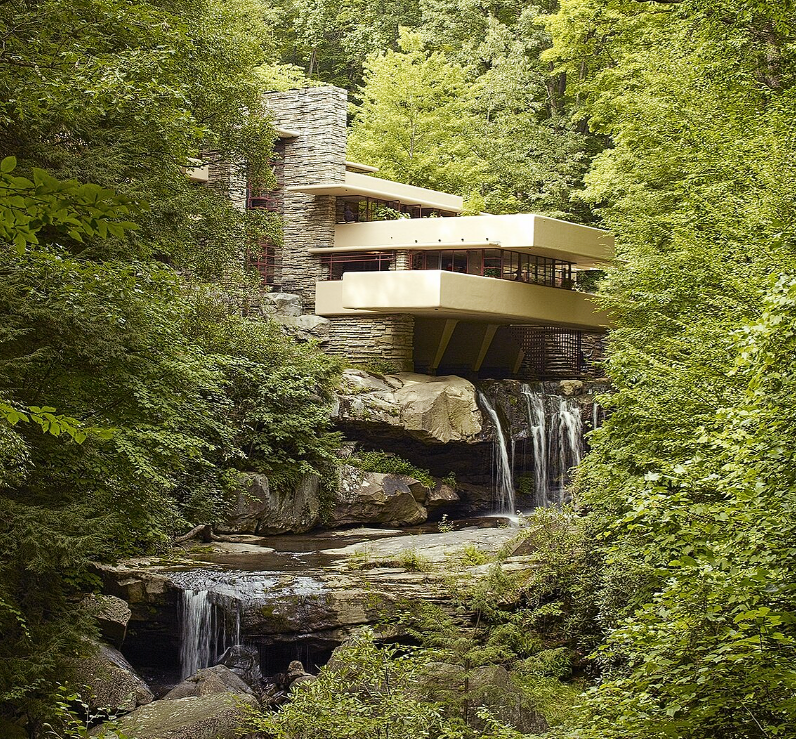
Frank Lloyd Wright (1867–1959) was an American master of organic architecture, known for Fallingwater and integrating buildings into nature. The Fallingwater (1936) project provides an interesting study on reinforced concrete possibilities and displays a unique non-Aalto-like approach towards nature. The latter is best reflected in the three-tiered set of heavily overhanging terraces that seem to float above a significant waterfall. In this case, decoration of the surfaces gives way to a rough look that includes courses of yellow stones in horizontal layers contrasting against the smoothness of stucco facades of the terraces and roof structures. The windows are sunk into recesses, while narrow mullions dividing the glazing contribute to delineating the spaces between the floor and the roof level, resulting in indoor-outdoor spaces. Fallingwater is a beautiful example of how modernism can take into consideration human needs.

Fig. 3 Fallingwater
Walter Gropius (1883–1969) was the founder of the German Bauhaus school, a cornerstone of modern design education. In 1919, Gropius (1883-1969) became the director of an architectural school which had just been founded following the consolidation of two already existing art and crafts schools. Unlike the German Werkbund, however, the Bauhaus took on a far more visionary approach with the aim of developing a unique and revolutionary teaching philosophy which would blend art and craft with industrial production. The need to move to Dessau because of budget cuts in the Bauhaus’s hometown, Weimar, led to a redefinition of the institution by Gropius. The Bauhaus teacher, Johannes Itten, left at this time and his place was taken by the Russian painter, Wassily Kandinsky.

Fig.4 Bauhaus school
Modernist architecture was seen as not only aesthetically but also politically revolutionary, even though these assertions were dismissed entirely by postmodernism during the second half of the twentieth century. Many Modernist architects such as Le Corbusier genuinely believed architecture could improve society itself. However, some Modernist ideas did not work as intended due to overlooking human needs.
The study of Modernism raises the question of whether architectural design ought to be solely focused on efficiency and cleanliness or whether an environment must consider other factors, such as emotion, identity, and social interaction, to be successful. While it is true that Modernism brought about a permanent change in architecture, there are many aspects of human experience were overlooked within its design philosophy.
References:
- Oxford University Press. (n.d.). Modernism, n., 4. In Oxford English dictionary. Retrieved November 19, 2025, from https://doi.org/10.1093/OED/1672218026.
- RIBA. (n.d.). Modernism. https://www.riba.org/explore/riba-collections/architectural-styles/modernism-movement/
- Ching, F. D. K., Jarzombek, M. M., & Prakash, V. (2017). A global history of architecture. John Wiley & Sons, Incorporated.
- Murphy, K. (2014, September 22). Modernism and architecture. In Grove Art Online. Oxford University Press. https://www.oxfordartonline.com/groveart/view/10.1093/gao/9781884446054.001.0001/oao-9781884446054-e-7002271597
Figures:
- Figure 1.Ching, F. D. K., Jarzombek, M. M., & Prakash, V. (2017). A global history of architecture. John Wiley & Sons, Incorporated.
- Figure 2.“File:Seagram Building (35098307116).jpg” by Ken Ohyamalicensed under CC BY-SA 2.0. To view a copy of this license, visit https://creativecommons.org/licenses/by/2.0/
- Figure 3.“File:Fallingwater 2007.jpg” by Carol M. Highsmith no copyright licence as photo is public domain
- Figure 4.“File:2020-09-18-Bauhaus-Dessau-Werkstattfluegel-Ecke-2.jpg” by Gunnar Klack licensed under CC BY-SA 4.0. To view a copy of this license, visit https://creativecommons.org/licenses/by-sa/4.0/
Leave a Reply